Starting a new project management role can feel as if everyone else has received a map that you were not shown. There may be a plan, a set of meetings and a folder full of documents, but that does not mean the position is clear.
Your first week is not about proving that you have all the answers. It's about finding out what matters, who knows what, and which questions need a proper answer before you make a bigger decision.
Begin with three simple aims
By the end of the first week, aim to have:
- a plain-English explanation of why the project exists;
- a list of the people whose decisions, knowledge or support will affect it; and
- a short note separating what you know, what you think, and what you still need to check.
That's a useful start. It's also more valuable than a new colour-coded dashboard built on guesses.
1. Ask what success is meant to look like
Start with the project's purpose and expected outcome. Ask the sponsor, manager or person handing over to you:
- What problem is this project meant to solve?
- Who should notice a positive result?
- What must be delivered, and what's outside the project's scope?
- Which date or commitment matters most?
- What would make the project fail?
Write down the answers in ordinary language. If two people give different answers, record the difference as a question. Do not quietly choose the version that sounds most convenient.
2. Find the current plan, but do not assume it is current
Look for the latest plan, milestone list, business case, decision record, risk log and recent status update. Check the dates on the files and ask who maintains each one.
You're not trying to audit every line in your first week. You're looking for signals:
- Are the next few milestones understood by the people doing the work?
- Are owners named for the important outcomes?
- Are decisions waiting for someone outside the project?
- Do the reported dates match what the team is telling you?
- Are there risks or issues that have no owner or next action?
When the documents disagree with each other, keep both the disagreement and its source visible. A tidy record of uncertainty is more useful than false precision.
3. Speak to the people who see different parts of the project
Make time for short, focused conversations with the sponsor or client, delivery leads, users or operational colleagues, and anyone responsible for a key dependency. You do not need a perfect stakeholder map before you start. You need to learn whose view is missing.
Useful questions include:
- What's going well?
- What's worrying you?
- Which decision is taking too long?
- What do you need from the project manager this month?
- Who else should I speak to?
Listen for differences in expectations, not just complaints. A stakeholder who is quiet may still control an approval or be affected by a change.
4. Start one short evidence note
Use three headings:
- Confirmed
- Information supported by a document, decision or conversation you trust.
- Provisional
- A reasonable working view that still needs testing.
- Open questions
- Information you need before you can make or recommend a decision.
This note is deliberately small. It gives you somewhere to put early learning without turning every conversation into a formal report.
5. Record risks, issues and dependencies as you find them
A risk is something that might happen and affect the project. An issue is a problem that is already happening. An assumption is something the plan is relying on that still needs checking. A dependency is something the project needs from another person, team, system or supplier.
You don't need a perfect register on day one. Record the description, owner if known, next action and date to review it. If you don't know the owner or date, write that down rather than inventing one.
This small habit helps you connect what people tell you to the work that needs attention. It also makes your first weekly update more useful.
6. Finish the week with a provisional position
Your first update does not need to declare the project green, amber or red without explanation. It can say:
The project purpose is understood, but the delivery date and supplier dependency still need confirmation. The team has identified two immediate actions, and the next review will confirm the owner and date for each.
That sentence is more helpful than “everything is being monitored”. It tells people what is known, what is uncertain and what will happen next.
What to avoid in week one
Avoid making large changes simply to show activity. Avoid promising a date before checking the dependencies. Avoid filling gaps with assumptions because an empty field looks untidy. Avoid sending a long status report that gives nobody a decision or action.
There may be an urgent problem that needs immediate action. Deal with it. But distinguish urgent stabilisation from improvements that can wait until you understand the situation better.
A practical next step
Build your first month from the project evidence, not guesswork.
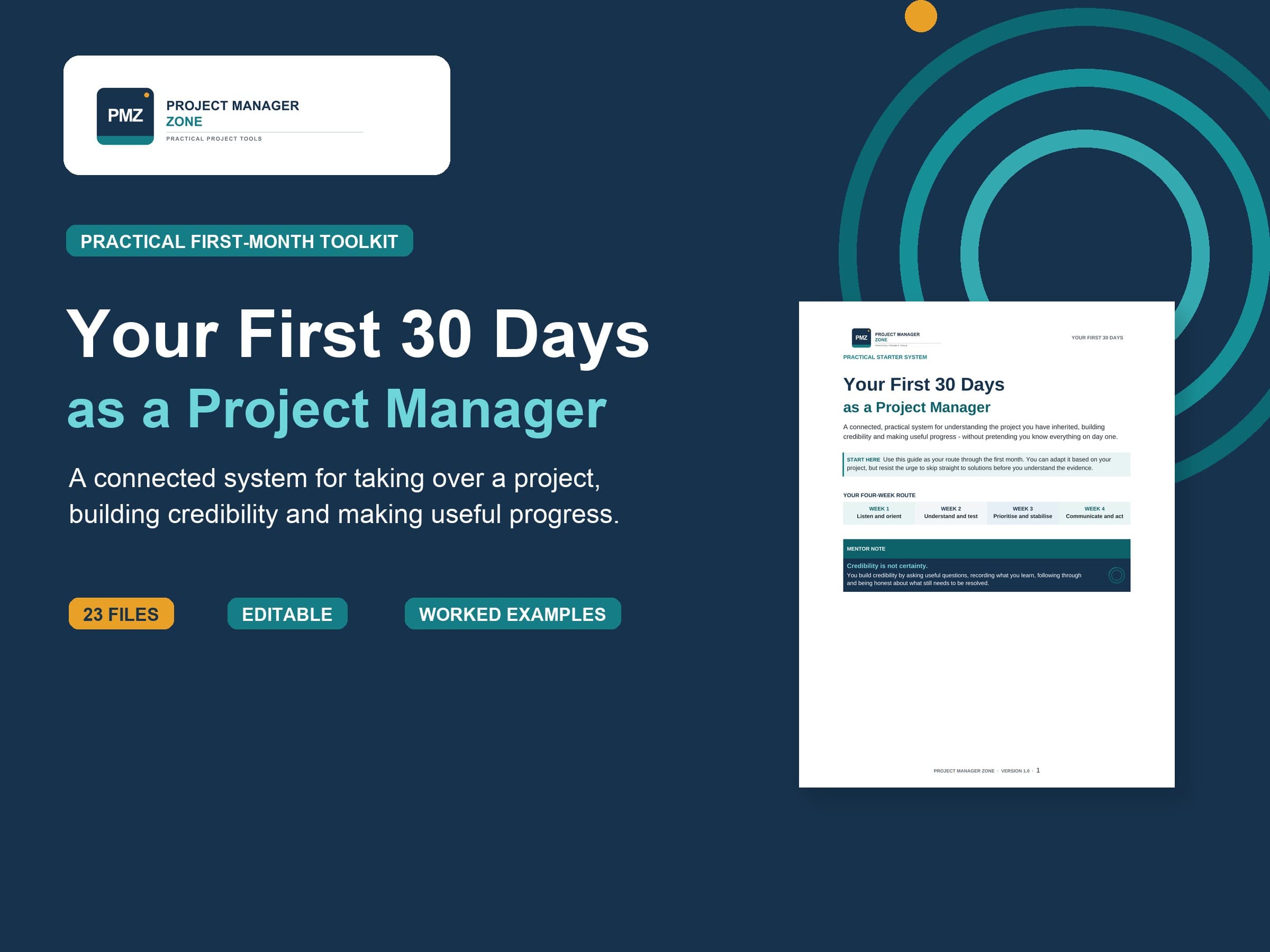
Project Manager Zone's Your First 30 Days as a Project Manager toolkit includes a 30-day action plan, a project takeover health check, stakeholder tools, a RAID starter register, an immediate priorities tracker and a first weekly status guide. It also includes a fictional worked example showing how the documents and records work together.
See the toolkit details, then decide whether the Etsy download is suitable for your work. The files are editable, but they are a starting structure: adapt them to your organisation, project and judgement.
Sources and further reading
This article is practical guidance from Project Manager Zone. It is not a substitute for your organisation's governance, legal, security, procurement or professional requirements.